
OPEC's move to cut output has pushed up oil prices. From here it could go either way: oil could reach $100/barrel or an analysis of demand and supply might follow, say Abheek Barua & Bidisha Ganguly.

The fuzziness of Trump's economic blueprint remains the biggest risk.

If banks have a surplus, they have the option of parking the money with the RBI.

Asian emerging market stock prices did see a bounce post Fed-talk.

'China could place the currency on a par with global biggies. But it has to wait to be a serious challenger.'

Political risk culminating from elections in the US and Latin America, and evolving right-wing populism in Europe could lead to substantial volatility, say Abheek Barua & Tushar Arora.

Foreign exchange reserves of the oil producers have increased by $1.1 trillion over the past decade.
Non-performing loans in the Chinese banking system stood at RMB 1.27 trillion at the end of 2015.

Following are comments from economists at leading financial institutions, banks and rating agencies on the interim Budget:

Of the six-member rate-setting monetary policy committee, five members voted for a 25 bps cut while one by 40 bps, the RBI said.

The silver lining is that a pick-up in the US economy could help emerging market exports.

The trinity of rising stocks, rising yields and rising dollar since Donald Trump's election has already faced a setback.
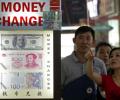
China's move to devalue its currency has exposed the fragility of its economy.

The markets stayed on edge last week due to the endless saga of Greece's problems.

The next round of bad news could come from Europe, where banks in a number of economies such as Italy, Portugal and Greece are sitting on mountains of bad loans.

The markets, at this point, have rallied on the view that the Fed will not budge from the zero-bound as long as inflation remains subdued

It can be noted that the rupee lost nearly 7 per cent since the beginning of May as FIIs have pulled out nearly $4 billion from the domestic debt, as bond yields fell on expectation of RBI cutting rates on Monday.

The NDA government was initially reticent about fleshing out its economic strategy for the future. But now that it has taken enough bold initiatives on the economic front it must have the confidence to tell us more about its approach going forward, says Abheek Barua.

The economy hasn't gathered even half the traction that some of us assumed it would just a year back.

Many things are going unnoticed by India watchers.

Gold has risen sharply due to rising risk aversion

A combination of reduced cash intensity, a focused strategy of tax administration and GST is the way to go, say Sakshi Gupta, Tanvi Garg and Abheek Barua.

A comprehensive solution involves a complete overhaul of our education and training model.

The unemployment situation is becoming increasingly acute.

For one thing, US Fed Chairman Ben Bernanke was perhaps right in postponing the quantitative easing taper even though the markets had complained at that time that they were primed for some reduction in QE3 and the Fed had missed an opportunity to execute their plans without causing too much of a flutter.

If the RBI governor's logic holds, the rupee is far from being extremely overvalued.

Having exposure to international funds and gold is a must for those who have foreign currency-denominated goals.

RBI's out-of-turn rate cut has surprise few economists.

Most mainstream researchers agree that good governance is a necessary condition for growth.

Investors have turned cautious ahead of the policy meetings of central banks in Japan and the US
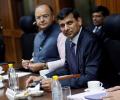
Balance is needed in selecting members for the proposed monetary policy committee, says Abheek Barua.

The central bank may need to further ease the rates by 50-75 bps.

The Reserve Bank of India kept its policy interest rate unchanged at a five-year low of 6.50 percent on Tuesday.

The central government's deposits with the RBI had fallen to just Rs 100 crore as of June 8.

RBI's status quo on rates disappoints economists.

At a pre-Budget meeting, the FM was asked to ensure that NBFCs come out of the liquidity crisis they are facing with the help of RBI. They also spoke about the futility of trying to achieve a 3 per cent fiscal deficit target over the medium term.

Urjit Patel's reappointment will raise market hopes that Rajan, will also be offered an extension when his tenure ends in September.
he reason behind the cut in policy rate seems to be a slowing economy
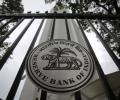
By no means do economists see the Reserve Bank of India stop at just a 25-bp cut. Some of the economists such as Soumyakanti Ghosh of State Bank of India are of the firm view that rates have room to fall by a total of 75 bps in the current financial year, starting with 25 bps in the August 7 policy.

India's central bank kept its key repo lending rate unchanged at 6.75 percent on Tuesday.
